
NVIDIA Officially Unveils GeForce RTX 5050 Desktop Graphics Card, Starting At $249 & Launch In Mid-July

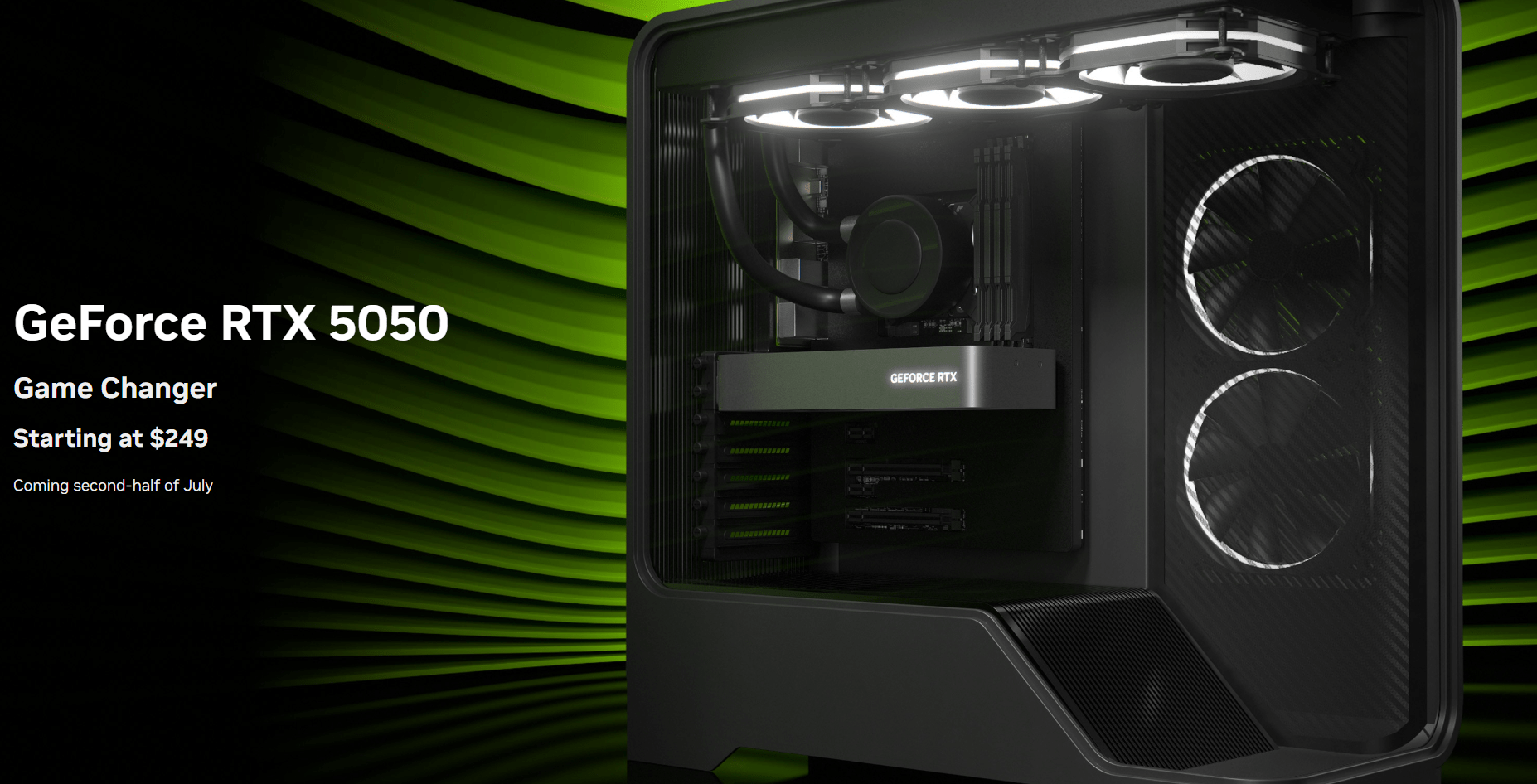
NVIDIA’s RTX 5050 is now up on the official website, revealing its full specifications and price. The GPU is the seventh SKU in the RTX 50 series and will be launched for retail next month.
NVIDIA Releases GeForce RTX 5050 with 2560 CUDA Cores, 8 GB GDDR6 Memory, and 130W TDP; Availability will be in the Second Half of July
After releasing the laptop GeForce RTX 5050 earlier today, NVIDIA has officially launched the desktop variant as well. The original plan was to release the graphics card at the end of July, but one of the recent reports indicated that NVIDIA is pushing the launch to 1st July. However, NVIDIA officially unveiled it today, as you can check on the website.

The page reveals the specifications of the GPU as well as its pricing and availability. The GeForce RTX 5050 is the seventh card in the Blackwell GeForce RTX 50 family and is based on the GB207 die. It boasts 2560 CUDA Cores and 8 GB GDDR6 VRAM, confirming the previous rumors that NVIDIA will not upgrade the VRAM to GDDR7. However, the laptop variant comes with faster GDDR7 memory.
The memory bus width is 128-bit, and the total memory bandwidth is 320 GB/s, which means the GDDR6 memory on the card runs at 20 Gbps. This aligns with previous reports, which indicated that the memory on the RTX 5050 will run faster than the memory on the GeForce RTX 3050 and RTX 4050.

The RTX 5050 brings the 5th gen Tensor Cores and 4th Gen Ray Tracing cores and can deliver up to 421 TOPs of AI performance. This is almost six times higher than the GeForce RTX 3050. The total graphics power is 130W, and NVIDIA recommends using a 550W power supply. The RTX 5050, therefore, carries a single 8-pin PCIe connector.
As far as the reference edition is concerned, it will feature 2.31 GHz of base and 2.57 GHz of boost clock.
RTX 5050 vs RTX 3050
- Blackwell Architecture vs Ampere Architecture
- Same 2560 CUDA Cores
- Faster RT & AI Cores
- Same 8 GB Memory
- 20 Gbps vs 14 Gbps GDDR6 Memory (+43%)
- 320 GB/s vs 224 GB/s Bandwidth (+43%)
- Same 128-bit Bus Interface
- Same 130W TDP
- Same $249 US MSRP

Given the entry-level nature of this graphics card, we should expect all AIB partners of NVIDIA to have a custom variant available at launch. There will be no Founders Edition model, although a 5-phase VRM design is expected to be used on most reference PCB designs. Expect more on the RTX 5050 in the coming months. It will be interesting to see how the market reacts to another entry-level 8 GB product.

Regarding performance, NVIDIA compares the GeForce RTX 5050 with the RTX 3050 and states that it can offer up to 4x the performance uplift with DLSS 4 enabled. At the same time, some non-DLSS numbers are also provided for eSports titles such as Apex Legends, Counter-Strike 2, and Overwatch 2, which show around 50-60% improvement.

They also added an NVIDIA RTX 4050 Laptop GPU for comparison, which is an odd choice. Here, the difference falls to 10-20%.
NVIDIA has announced that the GeForce RTX 5050 desktop GPU will be available in the second half of July, and its price will start at $249. It will be positioned in the entry-level segment with a pricing, right below the $299 US GeForce RTX 5060. The card will be competing with the Intel Arc B580 12 GB and Arc B570 10 GB GPUs, which retail for $219, and $249 US, respectively.
NVIDIA GeForce RTX 50 GPU Specs (Official):
| Graphics Card Name | NVIDIA GeForce RTX 5090 | NVIDIA GeForce RTX 5080 | NVIDIA GeForce RTX 5070 Ti | NVIDIA GeForce RTX 5070 | NVIDIA GeForce RTX 5060 Ti | NVIDIA GeForce RTX 5060 | NVIDIA GeForce RTX 5050 |
|---|---|---|---|---|---|---|---|
| GPU Name | Blackwell GB202-300 | Blackwell GB203-400 | Blackwell GB203-300-A1 | Blackwell GB205-300-A1 | Blackwell GB206-300 | Blackwell GB206-250 | Blackwell GB207-300 |
| GPU SMs | 170 (192 Full) | 84 (84 Full) | 70 (84 Full) | 50 (50 Full) | 36 (36 Full) | 30 | 20 (20 Full) |
| GPU Cores | 21760 | 10752 | 8960 | 6144 | 4608 | 3840 | 2560 |
| Clock Speeds | 2.41 GHz | 2.62 GHz | 2.45 GHz | 2.51 GHz | 2.57 GHz | 2.49 GHz | 2.57 GHz |
| Memory Capacity | 32 GB GDDR7 | 16 GB GDDR7 | 16 GB GDDR7 | 12 GB GDDR7 | 16 GB / 8 GB GDDR7 | 8 GB GDDR7 | 8 GB GDDR6 |
| Memory Bus | 512-bit | 256-bit | 256-bit | 192-bit | 128-bit | 128-bit | 128-bit |
| Memory Speed | 28 Gbps | 30 Gbps | 28 Gbps | 28 Gbps | 28 Gbps | 28 Gbps | 20 Gbps |
| Bandwidth | 1792 GB/s | 960 GB/s | 896 GB/s | 672 GB/s | 448 GB/s | 448 GB/s | 320 GB/s |
| Power Interface | 1 12V-2×6 (16-Pin) | 1 12V-2×6 (16-Pin) | 1 12V-2×6 (16-Pin) | 1 12VHPWR (16-Pin) | 1 12VHPWR (16-Pin) | 8-Pin | 8-Pin |
| Launch | 30th January, 2025 | 30th January, 2025 | 20th February, 2025 | 5th March, 2025 | 16th April, 2025 | 19th May, 2025 | July 2025 |
| TBP | 575W | 360W | 300W | 250W | 180W | 145W | 130W |
| Price | $1999 US | $999 US | $749 US | $549 US | $429/$379 | $299 | $249 |


